Almost 3 years ago, I have built and installed a couple of air quality monitoring nodes around the city of Niš. The whole journey is described in the previous blog post. During the last years, the situation regarding air pollution hadn’t changed, it has become even worst. So… I haven’t stopped building Pengies, upgrading their design, and installing them. This is a small update on the current state.
System concept
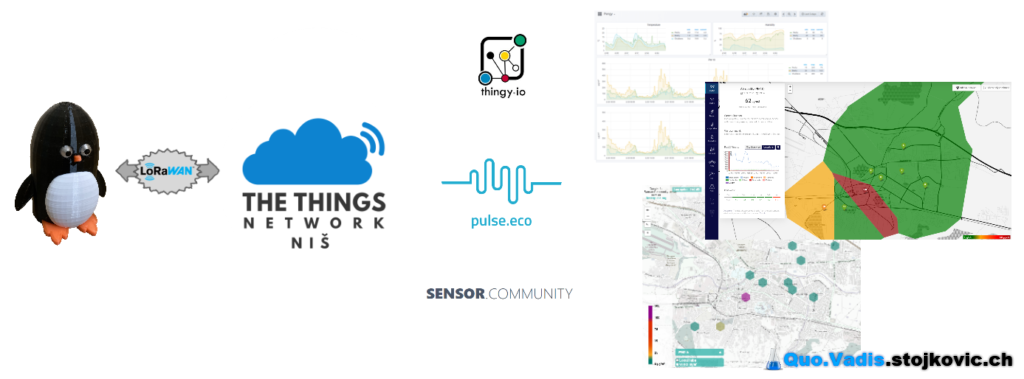
There has not been major changes with the system concept. Data is still transmitted using LoRaWAN connectivity and The Things Network community provider. Once collected and aggregated in thingy, it is pushed to pulse.eco and sensor.community platforms.
Acquisition
After some experimentation with various sensors, the design got stabilized with some proven-in-action sensors.
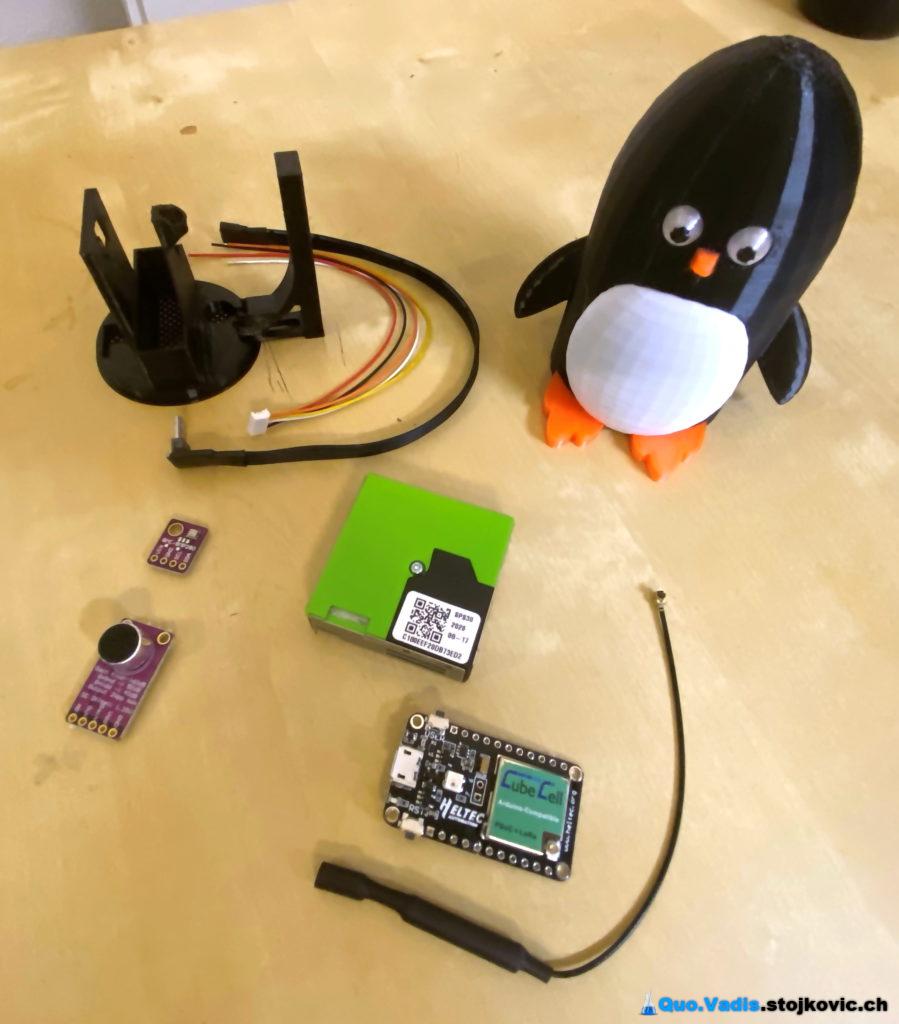
For measuring temperature, relative humidity, and atmospheric pressure Bosch’s BME280 is used.
For measuring particulate matter concentrations Sensirion’s SPS30 is used providing respirable (<10μm), fine (<2.5μm), and ultra-fine (<1μm) particle concentrations.
For measuring environmental noise levels, a MAX9814 amplifier-based microphone is used.
The noise is sampled continuously every 1 minute. The temperature, the humidity, and the pressure are sampled every 5 minutes, the respirable and fine particulate matter concentrations are sampled every 10 minutes. Every 20 minutes, all those values are averaged and transmitted.
Node
The core of the Pengy has been upgraded to the Heltec’s Cube Cell HTCC-AB01. Among many other things, this module bring better MCU, more RAM and on-board RGB LED. The module comes with integrated support for LoRaWAN based on SX1262.
Enclosure
The enclosure went through big transformation. It is now custom 3D printed design. All electronic components fit perfectly in it.
Integration- LoRaWAN / The Things Network & Visualization
The main integration point remained The Things Network. Pengy device is also available on the official LoRaWAN® Device Repository.
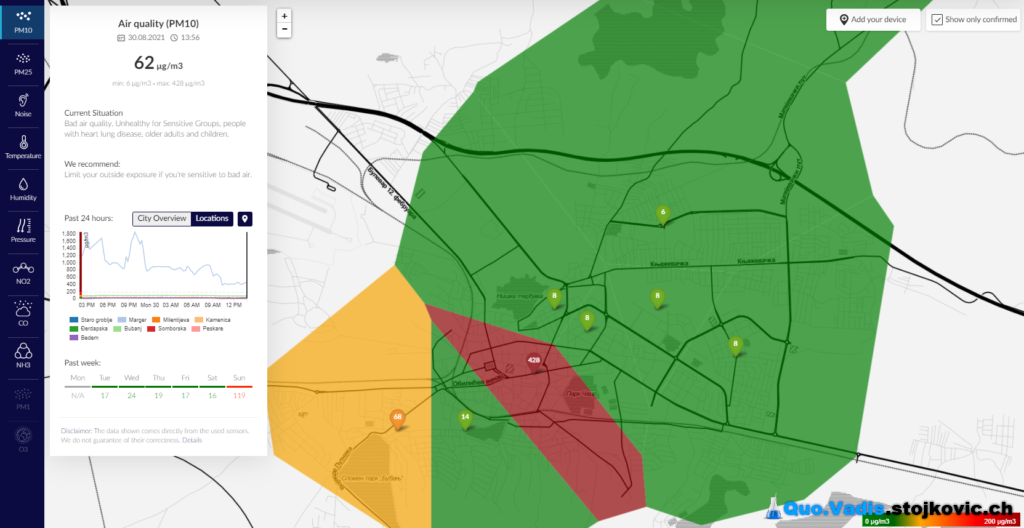
Nothing major changed in the area of visualization. Already established platforms sensor.community and pulse.eco are used to present data collected by Pengies.
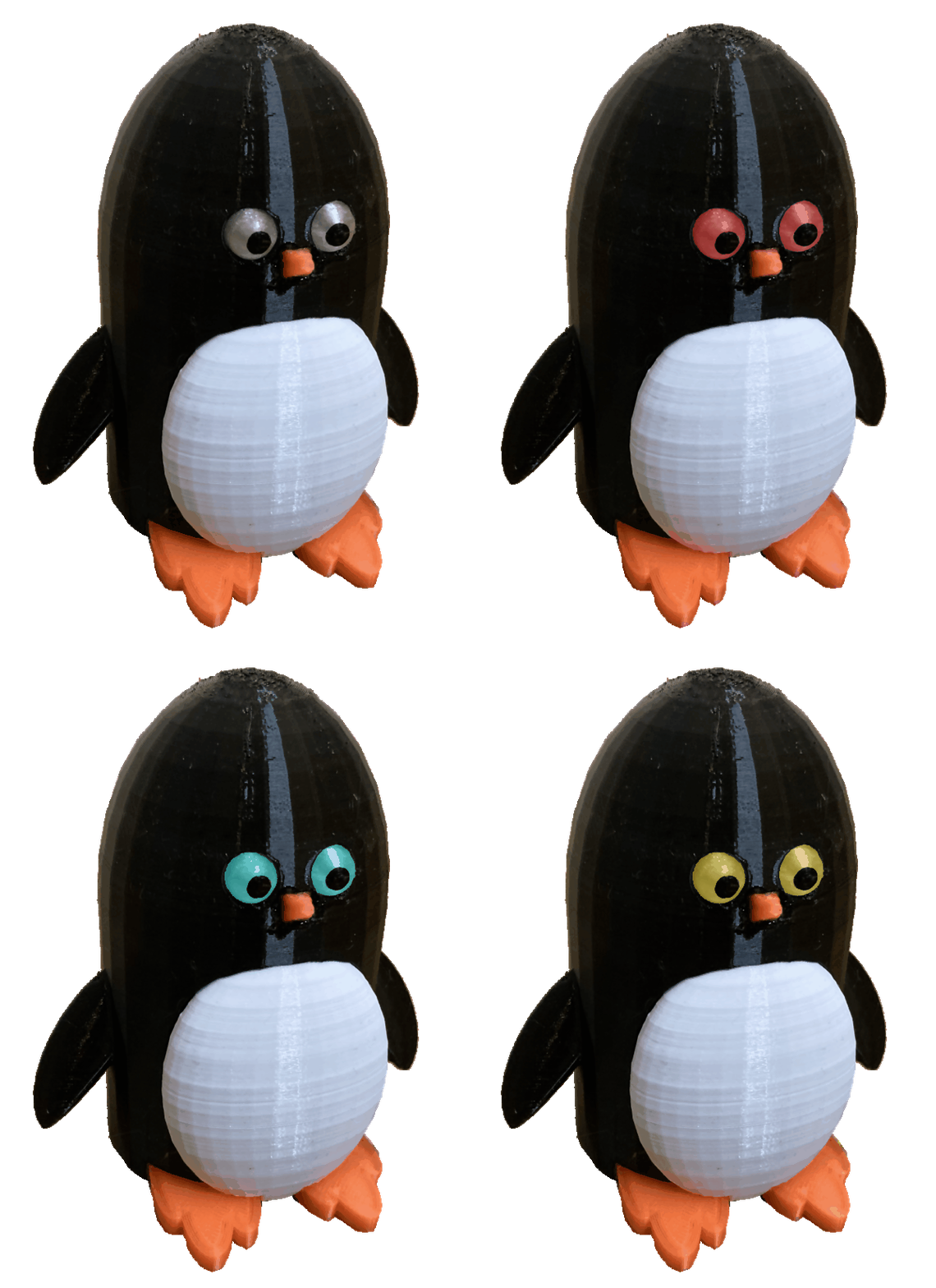
A visible upgrade is that now the Pengy can tell itself the current air quality using its eyes:

Color coding is according to the Europian Air Quality Index methodology – http://airindex.eea.europa.eu/.
Construction
Assembling of the device is straightforward. Electronic components are soldered together using the simple schematics, and afterword placed in carefully designed slots of the 3D printed enclosure. 3D printed enclosure consists of multiple parts, some of which need to be glued together.
More details and all neceserry artifacts can be found on project GitHub at https://github.com/dusanstojkovic/pengy/.
© 2021, Quo Vadis ?. All rights reserved.
